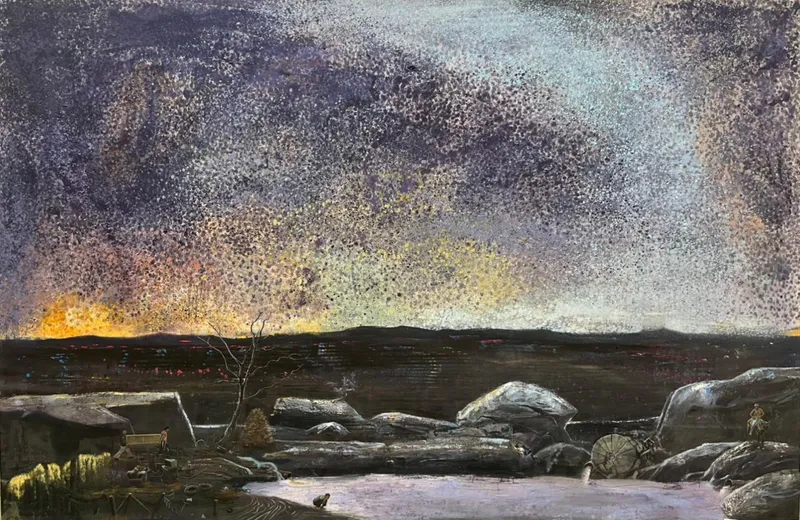
We are in a car cemetery. A mountain range composed of scrap metal surrounds a portion of radioactive water. The crumpled car bodies, stacked atop one another, limit the horizon, nullify the vanishing point, and loom monstrously, advancing upon us. These people-carrying machines are now at a standstill, their tires spinning in vain, every piece part of a total ruin. However, as the gaze lingers over this metallic mass, the painting reveals a profusion of details: human figures emerge from the wreckage, small actions insinuate themselves, and the mundane establishes itself. The mountain of cars ceases to be a mere compact block and begins to function as a narrative field. Each character seems to carry a possible story. Are they survivors of a world that collapsed or natives of this chaos? Do they move among the carcasses like those searching for a lost future or like those who have already learned to live among remains? The painting offers a stage for the observer’s inquiries, opening space for multiple hypotheses: perhaps they hope to rebuild something, perhaps they will finish destroying it.
This figurative universe is the result of Mateus Moreira’s technical itinerary, presented here in this new series of paintings. The artist seems to see the ambiguity of things as his engine—the very thing that motivates the painting. Sometimes it is a smudge of color that looks like a dog; at others, an accident that resembles a river. There are also those images that arise from his experiences, whether awake or asleep: enigmatic scenes caught between despair and hope, success and failure, progress and destruction. Faced with these poles, it is surprising that he does not apply judgment, nor does he lock each painting into a moral narrative that denounces the bankruptcy of civilization or preaches its resilience. On the contrary, he has the courage to let the scenes open up to a relationship with the public who—saturated with contemplating images of beginnings and ends—can now take a stand before them.
In the path that Mateus skillfully constructs, dredging us into his world, there is a demonstration of the dual aspect characteristic of any aesthetic experience. On one hand, the eye perceives the narrative. On the other, the same surface asserts itself before us as a work of art, made of lines and masses of color, spread with a palette knife or resulting from brushstrokes. The viewer must continuously oscillate between these two registers. The artist himself balances on this frontier at all times. From the sketches in his small notebook to the large canvases, he produces accidents, small cataclysms that corrupt the image, erasing constructed parts and adding dissonant elements, on the threshold between finishing and starting a new work from scratch.
This tension is a constituent of the represented scenes. The wreckage may indicate a civilization that has collapsed—or the raw material from which something new is about to be rebuilt. Although the paintings do not refer to any specific place in the world (and at the same time to all of them), the way of inhabiting this ambiguity is certainly characteristic of survival in Brazil: a precarious country that converts failure into a way of life, getting by as it can; where the flaw is a resource for the imagination. As in the painting itself, here too the meaning remains suspended between two poles: ruin and possibility.
Yuri Quevedo
