The sertão is an immense waiting.[1]
The exhibition “The Wind Is Green” brings together new works by Isaura Pena, Júnia Penna, and Louise Ganz, artists who explore ways of experiencing the landscape as an index of a processual temporality, in which nature and history intertwine as inseparable elements of transformation. Far from a romantic stance that regards nature as an idyllic image of a lost paradise, the artists perceive it as culture, the result of human and non-human agency in interaction with the natural world. As in the literature of Rosa, the immersion in the landscape of Minas Gerais serves as the impetus for the transcreation of a language that establishes new poetic universes. Despite their distinct appearances, these works engage with the extended temporality of gesture as it ventures through organic architectures grounded in a non-linear spatio-temporal flow. To some extent, there is both an attempt to preserve what is on the verge of disappearing and to register the irreversible advance of destruction.
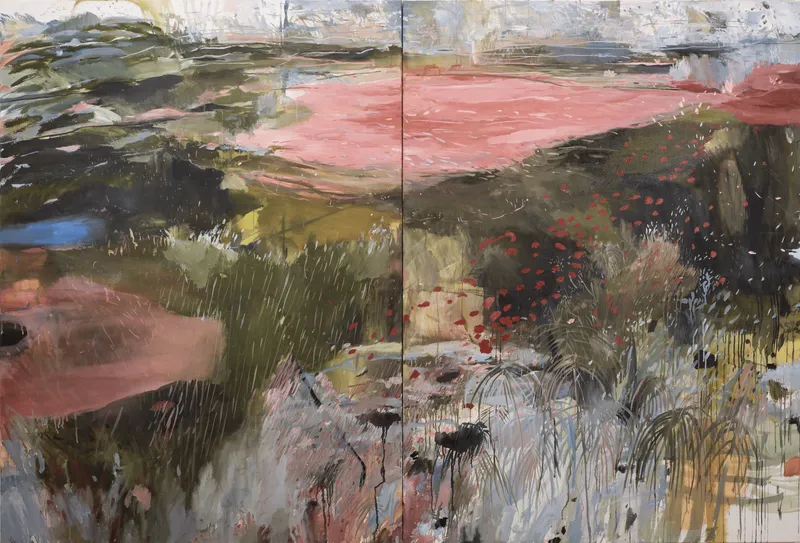
The paintings of Louise Ganz arise from the peripatetic exercise that characterizes her artistic trajectory. In walks through Parque Estadual da Serra do Rola-Moça, the artist observes and records the richness of the Cerrado biome, recognized for its vast biodiversity. The landscape is marked by grassy vegetation, shrubs with twisted trunks and thick bark, as well as trees with deep roots that have survived predatory extractivism since the colonial period. The region depicted by the artist is part of the so-called Quadrilátero Ferrífero, a territory that, in recent years, has been the site of recurring environmental and human disasters. It is an area constantly threatened by new forms of exploitation, perpetuating a long and tragic history of aggression against the environment that seems to repeat itself endlessly.
Far removed from the vision of naturalist travelers—who sought to frame the territory within a clear and ordered form—Louise recreates the landscape in its density of temporal experience, forming a tangle of lines and colored stains capable of expressing the synesthetic and bodily experience of natural abundance. The watery paint, which simulates a world in fusion, evokes the memory of the last liquefied landscapes painted by Guignard. A world observed simultaneously from near and far, in which the horizon line is malleable and seems on the verge of dissolving into formless materiality. These paintings reveal a process of continuous transformation, akin to the silent energy of underground waters.
In the large drawing from the “Focus” series, Júnia Penna creates twisted structures observed in Parque Ursulina de Andrade Mello, which had one-third of its area burned in 2024. Using graphite and twigs collected from the site of the fire, she draws an environmentally scaled network, establishing an organic architecture marked by lines that indicate paths made of deviations and continuities. Within this tangled web—developed slowly and cumulatively—one recognizes a kind of spontaneous ordering.
In Júnia’s works, textures and forms of nature are transformed into nearly abstract graphic elements. Trunks, leaves, veins, bark, vines, and fissures become components of visual construction. It is a slow and everyday labor of weaving, in which the artist’s action does not assert itself as imposition, but rather as attentive listening to matter, respecting its rhythms, resistances, and formal possibilities. As in the paintings of Louise Ganz, where making and observation are embedded in the very composition of the canvases, here too temporal experience unfolds into materiality. This is the case of the drawing “Untitled,” produced over six years. Initiated in 2020, during the Covid pandemic, the work continues to expand, as if the movement of the hand accompanied the organic growth of a living being. In this sense, the work incorporates the temporality of process into its own structure, materializing it in a geometry of irregular weavings.
In her drawings, Isaura Pena often investigates the various layers that shape a final form. Through a highly concise language—such as ink wash—she seeks to reveal the movement of transformation that characterizes any and all work. Such a procedure involves a temporality that points toward sedimentation, achieved through actions of addition, accumulation, repetition, and subtraction. In this line, the corporeality of the works (generally in tones of black, white, and gray) is the result of a slow and patient elaboration and transposition of forms through gesture and its superimposed displacements.
In the series of three drawings presented in the exhibition, Isaura draws upon the original floor plans of Parque Municipal de Belo Horizonte, designed by Aarão Reis and Paul Villon at the end of the 19th century as part of the project for implementing the new capital of Minas Gerais. A symbolic space of encounter between the urban and nature, the park soon became one of the city’s main attractions, as well as a setting for many artists and painters who sought to depict its landscape. Her intention is to recover the memory of its creation by combining overlapping lines of force that construct the projected landscape, which at its origin contains something imaginary, insofar as it already constitutes the elaboration of nature as culture. In the drawings, the passage between the organic and the abstract points to the transitional movement that characterized the park’s own history, which originally occupied a larger area. In the act of “redrawing the drawing,” the artist poetically preserves the layers that intertwine memory and disappearance.
Taisa Palhares
[1] Phrase taken from a letter by Manuel Bandeira to João Guimarães Rosa (03/13/1957), in which the poet comments on the impact of reading Grande sertão: Veredas. The phrase “The Wind Is Green,” which gives the exhibition its title, also appears in the letter.
